Alai-Pamir expedition 1928
It is known almost only to insiders that there were already German activities in the Pamir in the first half of the 20th century. First of all, reference must be made to the research expedition of W. RICKMER RICKMERS into this region in 1913 (RICKMER RICKMERS 1914, KLEBELSBERG 1914). Quite obviously, the explorer RICKMER RICKMERS wants to return to this region, which, due to the First World War and the postwar period, was only achieved in 1928. On the German side, this expedition was supported by the Notgemeinschaft der Deutschen Wissenschaft (Emergency Association of German Science) and the Deutschen und Österreichischen Alpenverein (German and Austrian Alpine Association). On the Soviet side, the Academy of Sciences was responsible for the expedition. The Soviet expedition leader was Nikolai Petrovich GORBUNOV from the Council of People’s Commissars. In the context of the exploration of the Pamir, this German-Soviet Alai-Pamir expedition of 1928 indeed plays a key role. It can be said without exaggeration that the scientific exploration of the Pamir begins with this expedition. Of course, travelers and expeditions of earlier years had already collected information about this mountain range, but until then these had remained largely selective and episodic.
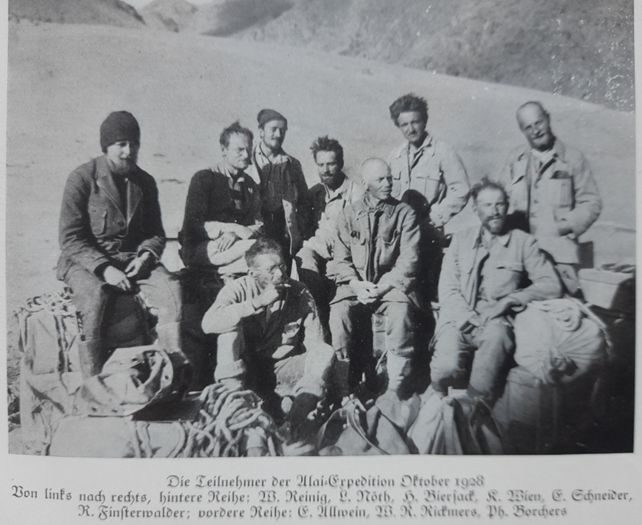
The Alai-Pamir Expedition of 1928 was the first to systematically explore larger parts of the mountain range, addressing topographical, geological, biological, and ethnographic (linguistic) questions, and published the results (FICKER & RICKMER RICKMERS 1932).
left: The German and Austrian participants of the Alai-Pamir Expedition 1928 (source: FINSTERWALDER 1929, p. 159)
Noteworthy are also the mountaineering achievements of the 1928 expedition. The climbers primarily placed themselves in the service of science and made it possible to access previously unexplored regions. Toward the end of the expedition in September 1928, the German and Austrian mountaineers A. Allwein, Ph. Borchers, E. Schneider, and K. Wien succeeded in the first ascent of the previously mentioned Pik Kaufmann, which, as already noted, was considered the highest mountain of the Pamir at that time.
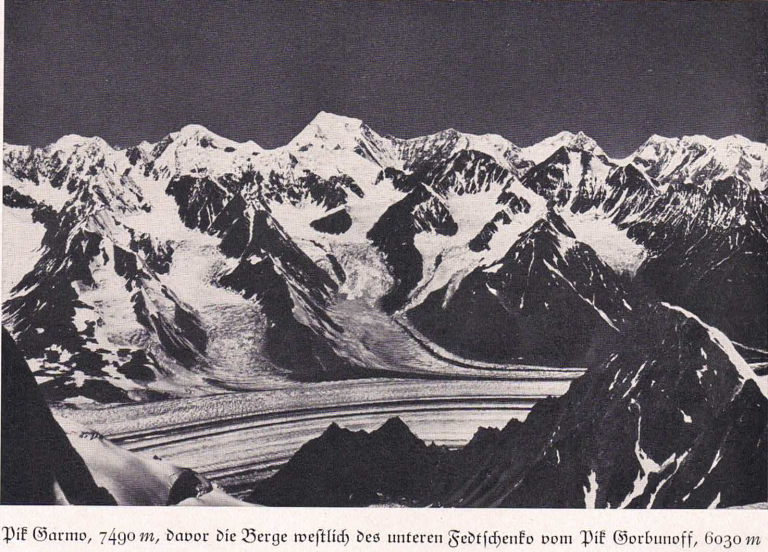
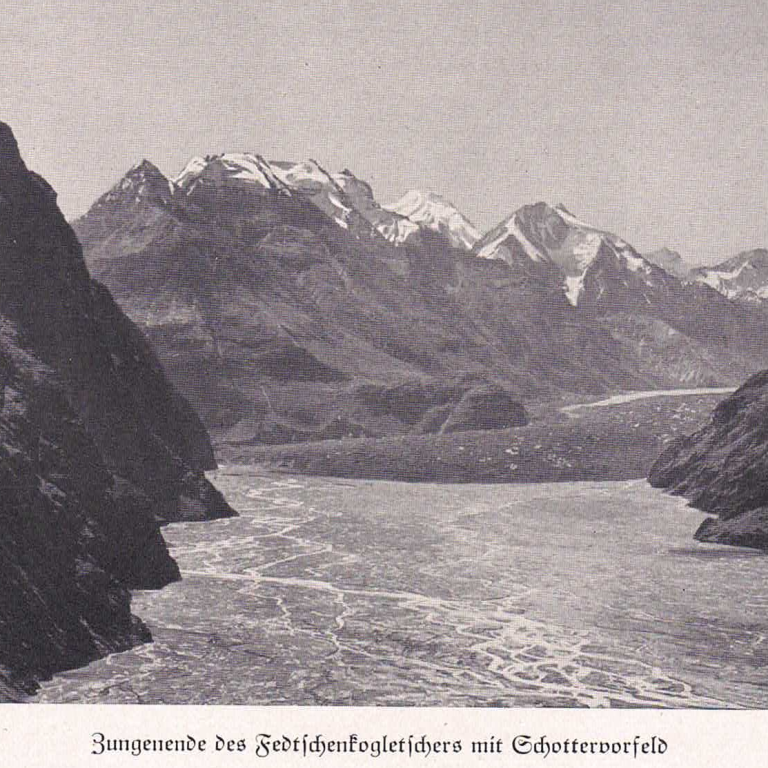
As a result of this expedition, a detailed topographic map of the northern part of the Pamirs was created on the basis of photogrammetric recordings for the first time. The Fedchenko Glacier was thereby classified as the longest non-polar valley glacier in the world, and in the evaluation of the photogrammetric images it was recognized that, contrary to previous assumptions, Pik Kaufmann (later Pik Lenin, today Pik Avicenna) is not the highest peak of the Pamirs, but that to the west of the area of the expedition there exists another, significantly higher peak, which represents the highest summit of the Pamirs. This mountain, originally named as Pik Garmo, was later renamed Pik Stalin and then Pik Communism as the highest peak of the Soviet Union, and today bears the name Pik Ismail Samani (Emir of the Samanid Empire, who is revered in Tajikistan as the “Father of the Fatherland”). All these clearly politically motivated renamings, however, have nothing to do with the 1928 expedition, which achieved outstanding scientific accomplishments.
There is also a film about the 1928 expedition, which is linked here: